Manneken Pis, fries and friturists: a very Belgian story
Posted on : 17-07-2026
On Saturday 1 August 2026, the most famous little urinating boy in Brussels, Manneken Pis, will be given a brand‑new outfit: a friturist’s costume, on the (much‑debated) International Day of Belgian Fries. He will also receive an honorary distinction from the National Order of the Golden Cone of Fries of the Union Nationale des Frituristes. That same weekend, Home Frit’ Home will open the doors of its Micro Belgian Fries Museum free of charge, to tell another story of fries and Belgian symbols, combining historical rigour, self‑mockery and surrealism.
Created at the end of the 17th century and attributed to Jérôme Duquesnoy, the statue is far more than a fountain: it embodies the rebellious, independent spirit of the people of Brussels. Numerous legends surround Manneken Pis, including the tale that he saved Brussels from a fire by urinating on the flames – a feat that raises a smile when you read comments from tourists surprised by how «small» the statue is and how close you have to get to really see it. Over time, Manneken Pis has become one of the most reproduced images of the city: on postcards, gadgets, posters and souvenirs, he has turned into a figure that is at once popular, touristic and deeply rooted in the city’s imagination. As a symbol of freedom of tone and self‑mockery, he happily lends himself to all kinds of variations, including culinary ones.
Belgian fries, Fritkot Culture and friturists without uniforms
If Manneken Pis is an emblem of Brussels, fries are one of Belgium’s major national symbols. Fritkot Culture, recognised as intangible heritage by all official components of the Kingdom since 2017, brings together the traditions and spontaneous creations that have grown up around chip stalls in all their diversity, with authentic Belgian fries forming the natural core of this universe. You encounter friturists of all kinds there, from traditional to unconventional, each with their own way of frying, serving and sometimes dressing, but without any real uniform. The word «frituriste» refers to these specialists of authentic Belgian fries, yet a clear corporate dress code simply does not exist: some wear cook’s outfits, others basic service clothing or streetwear, without any consistently identifiable sign directly linked to fries. Where other professions can be recognised at a glance, the friturist is defined first and foremost by his or her fritkot, by the way they work and engage with customers, and by the quality of their fries, rather than by their wardrobe. Designing a friturist’s costume especially for Manneken Pis therefore becomes a genuine tribute to Belgian fries, generously seasoned with surrealism.
Manneken Pis and fries: a very Belgian relationship
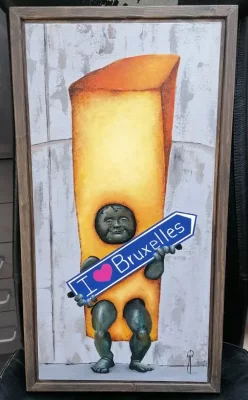
For decades, Manneken Pis has been closely linked with fries, another powerful symbol of the country, generating a whole imaginary in which the little urinating boy and a cone of fries go hand in hand. The iconic fountain thus becomes an accomplice of fries, with a strong dose of Brussels humour and second‑degree reading. Among the many variations on this theme, the character «Manneken Frites», created by Brussels artist MONK, holds a special place. Inspired by a Banksy‑style silhouette and initially named «Molotov Pis», this figure brings Manneken Pis together with the universe of fries in an urban, engaged and playful gesture. In 2014, «Manneken Frites» was presented in an exhibition at Home Frit’ Home’s Micro Belgian Fries Museum, and in 2015 the Museum of the City of Brussels acquired a statue of «Manneken Frites» for its Manneken Pis collections.
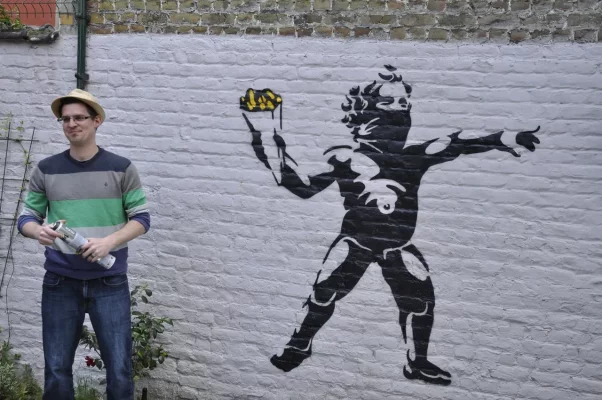
A Manneken Frites stencil at 242 Rue des Alliés in Brussels‑Forest
Beyond the statue, «Manneken Frites» also exists as an original stencil on the garden wall of the Micro Belgian Fries Museum at Home Frit’ Home, at 242 Rue des Alliés, 1190 Brussels‑Forest, freely accessible every first weekend of the month. This stencil echoes other interventions that once existed elsewhere, such as the one that decorated the shutter of the now defunct fritkot Fritkot Bompa, at 71 Avenue de la Couronne in Ixelles. In this way, Manneken Pis, fries and the city meet right on the façades of Brussels, combining memories of vanished fritkots with contemporary creations.
«Fries and Religion »: Manneken, Jeanneke and fries at the Micro Belgian Fries Museum
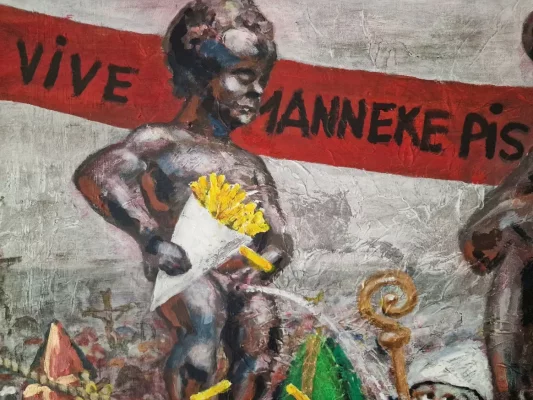
In the exhibition «Fries and Religion», which ends precisely on Saturday 1 August (13:30-18:30) and Sunday 2 August 2026 (13:30-18:00) at Home Frit’ Home’s Micro Belgian Fries Museum, Manneken Pis appears once again. Former journalist and TV presenter Jean‑Claude Defossé‑Dubié, also a painter, is showing the work «Jeanneke Pis et les marchands de bobards» (oil on canvas, 2017-2025). On this canvas, Manneken Pis and his counterpart Jeanneke Pis, two of Brussels’ «enfant terribles», call on fries for support to assert a rebellious, free‑spirited and self‑mocking attitude. Here too, fries are far more than a side dish: they become a symbolic ally in a landscape where myths, beliefs and narratives intersect with humour.
Facebook event «Fries and Religion»: https://www.facebook.com/events/1277287334583274
From Manneken Frites to Manneken Frit’: when Manneken Pis becomes a fritkot sign
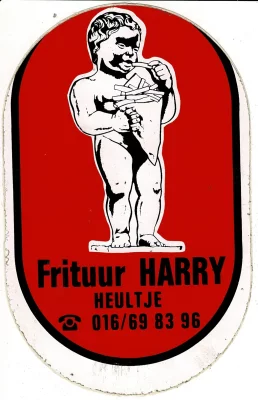
The relationship between Manneken Pis and fries is not confined to the realm of art: it also appears in the commercial world of fritkots. At times, Manneken Pis even becomes the emblem of a chip shop and ceases to be merely a Belgian symbol to turn into a provider of images of fries, often standardised. In Brussels, you encounter him notably at «Manneken Frites», a «friterie» on Rue du Midi 30 in the city centre. In the German‑speaking Community, in Hauset, the «Manneken Frit’» fritkot also uses the little urinating boy’s silhouette, while in the Netherlands the «Mannekenpis» chain operates under the subtitle «Verse Vlaamse Friet» in cities such as Utrecht, Amsterdam, Leidschendam and Den Haag.
1 August: friturist’s costume, International Day of Belgian Fries and open doors at Home Frit’ Home
Within this broader context, Manneken Pis will receive his friturist’s costume on 1 August 2026, on the International Day of Belgian Fries. The origins of this commemorative day are rather obscure and have already been examined in detail in an article on the Home Frit’ Home website, which questions whether this « International Day » is not, above all, a « Belgian joke »: "August 1st, International Belgian Fries Day: a Belgian joke?".
On Saturday 1 August (13:30–18:30) and Sunday 2 August 2026 (13:30–18:00), Home Frit’ Home and its Micro Belgian Fries Museum in Brussels‑Forest will be open to the public free of charge. Visitors will have the chance to see the «Manneken Frites» stencil up close, discover the «Fries and religion» exhibition, and explore other, sometimes serious, sometimes wry ways of telling the story of fries and their symbols. Throughout the weekend, the cult short film «Fritland» (1985, Super 8) by Yves Warson and Gilles Houben will be screened on loop. This road movie through the universe of fritkots across the Kingdom, from the end of the 1970s to the early 1980s, extends the visit with a filmed journey into the heart of Fritkot Culture. Between Manneken Pis in a friturist’s costume and the Micro Belgian Fries Museum in open‑door mode, this first weekend of August 2026 promises a very Belgian plunge into the world of fries, friturists and their many variations.
Add a comment